Caribbean Cruise 2012

January 24, 2012
We have just returned from a marvellous 10-day cruise from Fort Lauderdale to the Caribbean.  Rather than take up time from the working vacation (it was a quilting cruise, and we were singing and teaching quilting aboard), I thought I’d make my report to you all at once.  So…. this will be long. I promise lots of pictures!

We stayed at the Days Inn the night before, after our 10 day drive from home,  and took a shuttle to the ship the next morning.  It seems that this is a common thing to do in Ft. Lauderdale, because they’re very organized.  We waited in the “Noordam” line with everyone else.  I did meet some people who were heading out for a 103 day round-the-world trip.  I was green with envy!
Waiting for the shuttle

Our chariot was the Noordam, one of the Holland American “Dam” ships.  They are all laid out the same, and we have travelled on two of the others, so we knew our way around immediately. We went up to the Lido deck for the sendoff and to watch us head out to sea.  A sister ship was ahead of us.

The entrance/exit to Ft. Lauderdale.

DAY TWO

We woke the next morning at Half Moon Cay, Bahamas.  This is a small island that Holland America has leased from the government for their exclusive use.  It has a wonderful beach, very accessible, a bar in the shape of a pirate ship, and they offered a free barbecue for lunch.

Mostly what people did was lie on the beach!

We took a short bicycle ride with a group to see more of the island.  We were excited to stop at an enclosure in the lagoon where 7 stingrays were swimming around.  We didn’t go swimming with them, although we understood that others had done so.  We saw lots of hermit crabs and chameleons on our hike. We’re starting to see the colours of the Caribbean in the buildings.

We had our first formal night after we got back on board, and that’s when we discovered another group on the ship:  a Scottish clan family reunion.  From then on, we tried to spot the kilts and pipers…..

Where's the haggis, then?

DAY THREE

We had the morning for our welcome meeting, opening concert, introductions, etc.  We had met most of our group the night before, after leaving Half Moon Cay, at our group’s cocktail party.  We have a great group – quite a few repeat cruisers plus some newbies for us. We’ll have three days of classes on this cruise, and Daphne, Susan and I are ready!  We have designed the patterns, made kits and instructions, and brought them all with us in our suitcases.  This is so that, once we get rid of all these kits, we’ll be able to fill our suitcases with other purchases we’ll acquire as we go!  All our cruisers had do to was bring a basic sewing kit – we even provided the thread for the pieces.

We arrived at Grand Turk, Turks & Caicos at noon.  John and I had signed up for a kayak and hike shore excursion ahead of time, and we donned our swimsuits and headed out by bus along rickety roads to the lagoon on the north end of the island, passing lots of wild donkeys and horses on the way.  This is a small island as well, with not many people living there – but lots more than on Half Moon Cay.  Hurricanes in the Caribbean have stripped the tall trees on this island, so we didn’t see many palms there.  We were, however, VERY surprised to see Canadian banks in evidence!  I remember that several years ago there was a move by T&C Islands for Canada to take charge of them.  Everybody I know thought it was an EXCELLENT idea, because we don’t have anywhere in Canada to go to in the winter to warm up.  I don’t know what happened to this proposal, but T&C is NOT currently a part of Canada (*sigh*).

The other thing Turks and Caicos is famous for is that John Glenn splashed down very near these islands in 1962 – becoming an American legend in the process.

We arrived at the lagoon and hopped into our glass bottom kayaks for a leisurely paddle.  We saw lots of mangroves, checked out some spiny sea creatures and even tried some raw conch!  It was the consistency of calamari, but with a creamier flavour – yummy!

DAY FOUR

We had arrived at Samana, Dominican Republic by morning and were greeted by dancers and a small band as we disembarked.

The Welcome band at Samana

Of course, DR is the other 2/3 of the island where Haiti is – the island is called Hispaniola.  It’s still a poor country, but it’s in a much better state than its neighbour.  The earthquake did not affect Dominicans, and they have a government that believes in schooling for its children.  We took a bus tour to get an overview of the place – Samana is a peninsula on the northeast side, and is very oriented to tourism.  We learned of Mamajuana, a drink comprised of two fingers of honey, two fingers of red wine, and two splayed fingers (thumb and pinky) of rum!  It was very good……

They grow coffee, cocoa, tobacco, bananas, papayas and sugar cane on the island. I think you could live off the land very well there.  Everyone seems to have a handful of chickens, a pig, and a goat.  The houses are in various stages of completion – people get them started, then leave the cinder block walls until they have raised more money to do another stage.  We saw horses that the inhabitants ride to get to rough areas, or to see the huge waterfall that is tough to get to by road. There were motorized scooters everywhere.  It was laundry day in DR, and everyone had their washing hung out over everything, including the metal guard rails on the side of the road!

On the table there are containers of gasoline which they sell to the scooters.

Laundry day in Samana

The top side of the Samana peninsula is where the luxury tourist condos and white beaches are. We stopped for lunch and ate fish cooked in coconut milk, then we wandered around for a bit on the beach, watching the fishermen selling their wares and just enjoying our day off.

The beach at Las Terrenas - a classic Caribbean scene!

I bought a little carved sea turtle at a shop we stopped at, as well as a chunk of natural chocolate.  The coffee was yummy too.

What we didn’t do in Samana was go on a whale-watching tour.  Samana Bay is the nursery for humpback whales, and they come from a long way away to have their babies here in the warm waters.  Next time…..

DAY FIVE

During every day at sea on this cruise  we’ll be teaching quilting.  It’s a full day to get to the former Dutch Antilles islands, now known as the ABC Islands – Aruba, Bonaire and Curacao.  My class was called “Parrots of the Caribbean”, and 10 students made a huge mess (on purpose), to construct the bright parrots with fusible applique.  Most of them completed the piece, which I was thrilled about.

 After all those little, little pieces of fabric we threw around the room, it was pretty messy by the end! A good day was had.

Of course, a cruise would not be complete without towel animals!  We had one on our bed every night, and they were all very friendly and fun, even if they were a bit cross-eyed.

DAY SIX – BONAIRE

We had been told that the best diving and snorkelling would be found in Bonaire, so we booked a “2-site” snorkel trip for the afternoon.  In the morning we wandered around the port.  For the only stop on the cruise, the cruise ship dock area was not owned by the cruise companies, and that meant there were no diamond stores or tacky tourist stuff.  We were greeted with an open-air arts and crafts market and the vendors were usually the makers of the goods they were selling.  It was refreshing.

We found some locals cleaning fish by the bay, throwing the leftovers up to the circling frigatebirds overhead.  I must say that it was exciting to see so many frigatebirds and brown pelicans around.  Great for birdwatching.

Frigatebirds and brown pelicans waiting for fish scraps.

Our afternoon snorkel adventure set off from the dock beside the ship.  We were delighted to see the “Seacow” waiting for us, with three young, knowledgeable and helpful crew.
Seacow, our snorkelship

Our friends (and my teaching associate) Susan and Henry came along as well, and we spent a lovely afternoon in two separate diving spots on Klein Bonaire (“Little Bonaire”), where all the coral reefs are.  We have snorkelled on the Great Barrier Reef and it was a much shorter boat ride, but not quite as many fish or coral.  I’m afraid we’ve been spoiled forever…..  But we did see some green sea turtles swimming by at a distance, as well as a blowfish called a porcupine fish. When it’s in danger, it puffs itself up and the little tines stick out in all directions.  It would be terrifying to see. http://en.wikipedia.org/wiki/Porcupinefish or see a picture of it puffed out here: http://fishschooled.blogspot.com/2011/02/porcupine-fish.html

We also saw pink flamingos on the shore – first time I’ve ever seen them in the wild.  Boy are they ever PINK!!!

DAY SEVEN – Willemstad Curacao

Our next stop was Curacao.  This was a very touristy port with a distinctive Dutch influence, especially architecturally – with a tropical flair.

Bright buildings with a typical Dutch roof outline.

They celebrate their architecture on their licence plates too.

That’s their flag in the upper corner of the licence plate – blue above for the sky, blue below for the sea, and a line of yellow sand for the island.  I was interested to find out that the name Curacao is not from the drink of the same name! The origins of the name are probably Portuguese for “becoming cured” – the sailors on the earliest Portuguese ship that landed there were suffering from scurvy.  They were cured on the island, probably by eating fruit with vitamin C. The drink Curacao is made from fermented oranges – obviously a much more fun cure for scurvy.  And of course, one needs to keep imbibing, as a preventative!

We took a tour in the morning to see a bit of the island.  We hopped on a bus to look at the limestone caves near the airport.  There are caves all over the island – these ones in particular were where the early slaves would go to hide from the slave owners.  There were small fruit bats inside, flying about, which was neat to see.  Three or four large caverns with lots of stalactites and stalagmites, and pools of fresh water.  There were still signs of carbon on the ceilings from the torches of the slaves.

We drove down to the main part of town from there and continued on foot.  Our guide taught us a few words of Papiamentu, the local dialect which is a combination of African languages, Portuguese, Spanish, English and Dutch.  “Bon bini” is “welcome”; “bon dia” is “good day”; “danki” is “thank you” (obviously the Dutch influence there).  We walked by the floating market – Venezuelan boats come over every few weeks with their fresh produce.

Floating Market in Curacao

The shelves are built on dry land, but the boats are behind.

The floating part of the floating market

Then we were left on our own.  There were lots of shops to look in. We found a couple of fabric stores, which all the quilters visited throughout the day.  There were dressmaking fabrics, home decor stuff, and some African and Madras cotton prints, but I couldn’t find any blue and white Dutch fabric.  If you’re visiting, make sure you visit Ackerman’s, right on the front row of shops by the water.

This is what it looks like - Ackerman fabric shop

Dinner dress that night was supposed to be a tropical theme, so I bought a beautiful strapless smocked dress in a deep teal and wore it.  When I took it off, I was blue!!!  So now, it’s in a plastic bag in my luggage, awaiting a close encounter with Retayne when I get home….

DAY EIGHT – Oranjestad, Aruba

We arrived before dawn – in fact, I think we were there by midnight.  It’s not far between the ABC islands.  Aruba is our last port of call, and we decided to take it easy. No shore excursions.  Sleep in, have a relaxing breakfast aboard the ship, then wander around for a while.  Daphne told us about the historical museum in the old fort, so we headed off there.

These islands, despite being surrounded by water, are generally dry and desert like.  We saw lots of cacti on each of them, and in Aruba we saw lots of lizards.

Iguana in Aruba

And a very bright one!

The historical museum (where we saw most of the lizards) was small, but interesting.  It detailed the development of the island through resources like finding gold and oil, the slave trade, and salt exports.  Before the days of refrigeration, salt was vital for the preservation of food.  All of these islands we’ve visited have exported salt over the years.  In fact, in Grand Turk we saw the salt crystals on the lagoon edge – waiting to be harvested. Curacao has oil refineries keeping it going.  Of course, the impact of tourism cannot be understated as well.

We spent another couple of hours in search of a Bunge family “comfort food”: a Dutch candy called Hopjes.  We thought we might find some in the supermarket, but were disappointed.  We did find a Belgian staple, though: Speculoos, which we were introduced to in September by our friend Brigitte. It’s a cinnamon flavoured biscuit and/or spread that is quite delicious. We gave up looking for Hopjes after a while, and went back to the ship for a nap and some sun.  There’s only so much shopping we can take, and the shops were all starting to look alike. I did, however, buy a sun dress at the wharf.  It was very tropical looking, and I’m sure I can wear it again (and it didn’t run like the last one!).  One of our quilters, Deborah, from Texas was there, right behind me.  She fell in love with the same dress, so we both wore them to dinner that night!

Twins?

DAY NINE – At Sea

The ship has turned for home (Fort Lauderdale) and we have two days to quilt!  All three rooms were busy today:  Susan was teaching her Botanical Leaf Study, Daphne and her class were putting together their Caribbean Cottages, and I sat down with my students to work on hand Mola appliqué, à la the Kuna Indian tribe from Panama (San Blas Islands). I looked and looked to buy some Molas on our stops, but we are too far east for Panamanian souvenirs.

The joy of hand work on a cruise cannot be overstated – it’s calming, slow, repetitive, and conducive to great conversations.  We talked about our journey and experiences during the day.  Our illustrious Cruise Director of the ship stopped by to see what we were doing, too.  Here he is – Shane – with the class.

Shane with the gals from Jacksonville FL

Shane with the Victoria (and ex-Victoria) contingent

That night was the obligatory Dessert Extravaganza.  It started at 10:30pm (just when you want to chow down with a lot of sugar…..).  On our first cruise to the Mexican Riviera on Holland America, it was called the Chocolate Extravaganza and started at midnight.  I think this is better, marginally – at least, it’s earlier.  The chefs pull out their most exciting presentations for this event, featuring carved watermelons, fancy breads and TWO chocolate fountains (white and dark).

Just a small sample of the three-floor Extravaganza

DAY TEN – At Sea

Our last day on the cruise was jam-packed.  There was still a song to write with the non-quilting partners, classes by Susan and Daphne, the final wrap-up (talking about our next adventure in the fall of 2013 from New York to Quebec City to see the fall colours), a concert, the debut of our new song, and the most important: Show and Tell!

We started writing the song at 10am, and finished by about 11:35.  There were some old hands at this – Alan and Henry and John have participated ever since the first cruise – and some newbies.  We ended up paying tribute to the ever-present Bread Pudding (which was always available on the Lido deck) – but the song was really about what we saw and did on the cruise. The last chorus read like this:

We saw it all, we did it all
We ate it all, we drank it all
We’re so glad we’re still afloat
Not like that other boat…….

It was very well received!

Show and tell included purchases from the ports, as well as quilts and products of the classes.  Janet made a pirate quilt before the cruise and brought it for S&T.

Janet's Pirate quilt

Here’s one of the Caribbean cottages – what vibrant, tropical colours!

Carol's Caribbean cottages

Most of my students got their parrots finished in class.  They will go home to cut away the white base fabric behind the bird, appliqué it onto the green forest background and quilt it.  Don showed his parrot to everyone.

Don's Parrot

I don’t have any pictures of us all singing our new song on stage from the final concert – everyone else took them!  Maybe someone will send me a picture of that, so I can show you.

Then we got ready for our final dinner aboard the ship.  Eating on a cruise ship is a sumptuous affair, not so good for dieters.  It’s good to exercise restraint, but almost impossible.  I certainly found it so, especially on the last night.  It was a special dinner, and we could have up to 6 courses.  Not wanting to miss a single taste experience, I ordered all 6!!!   Our servers danced their way in to the dining room, waving napkins and generally being silly. It was their time to show off for us, and they enjoyed themselves.  It finished with them all singing a song of farewell, followed by the big Baked Alaska presentation.
Baked Alaska, anyone?

We really enjoyed sitting each night with Daphne, Alan and her mother Jean.  Lots of fun, you guys!

The next morning we arrived in Fort Lauderdale and disembarked into the city.  Most of our people were going right home – to Texas, Victoria, Alberta, Winnipeg, Jacksonville.  John and I will take a bit longer.  We are heading back to our reality – to lots of concerts and classes along the way.  Check out my website at www.singingquilter.com for details of our tour.

I hope you’ve enjoyed hearing about our adventures on this cruise.  It really is a lovely way to travel, and we are very relaxed, tanned and well-fed.  Now: back to work!

Yo, Ho, Ho…. and some Mardis Gras bling

January 12, 2012

Hello everyone: Thank you for reading this blog.  I haven’t been very active for a little while, as we’ve been driving for 9 straight days to get to Florida.  I don’t really have much to say about the drive. We’ve done it before, many times.  The weather got warmer as we got south, the rain stopped (until we got east), it got really dry across the deserts, and it started raining again in Texas (where they really really need it).  Flooded fields by Louisiana, and here in Florida, lots of wind.  We wake to the fog of Gainesville.  That means the wind has calmed, and our little boat trip should be smooth (I hope).

I found a great quilt shop yesterday in Panama City Florida, Quilting by the Bay. They were very friendly, helpful (one gal took me around to the horse fabric and then the patterns to show me what I could do with them - lots of great ideas!), and sent me off with some wonderful catalogues and shop fabric bags for our cruisers.  The next time we’re through, they want me to do a class with them.  I’m very impressed with this shop – it’s a real going concern.

I must tell you about one delightful stop on our drive.  We crossed the border into Alabama and stopped at the welcome center for lunch.  I recalled the last time we stopped here, and vaguely remembered a display inside, so I wandered in.  I was NOT disappointed!

The first thing I saw was a quilt on the wall, made by school children in honour of Hurricane Katrina.  It was very poignant.


This is the quilt, made with fused applique.


A poster beside the quilt to explain it.


I dream that construction was going quicker.

So I could live in my house again.

I hope the making of this quilt helped in the healing for these kids.

In the rest of the welcome center area I found some amazing gowns.  It’s Mardi Gras time here – in fact, the waiter at the Louisiana Barbecue place the other night had Mardi Gras beads around his neck!  They take their Mardi Gras very seriously in these parts, and the Welcome Center had an amazing display of Mardis Gras dresses worn in the parades.  Take a look at these!

I particularly love the rocket ship on this one!

So, happy Mardis Gras, everyone!  The next post from me will (hopefully) be from aboard the ms Noordam – our Holland America ship taking quilters to new adventures!!!

Australian Shadows

December 31, 2011

A few years ago I made a quilt, using techniques from the book “Casting Shadows” by Colleen Wise. It was designed with my own block, to use up some of my Australian Aboriginal fabrics, but not to cut them up into really small pieces, so I could continue to enjoy the fabrics.  Here is the quilt:

Australian Shadows

When we were in North Carolina, two years ago, we met Leah Day (http://freemotionquilting.blogspot.com/) who asked if I was going to release the pattern for this quilt.  At the time, I didn’t think I would, so I gave her permission to make a pattern of it – or, at least, of her version of it.  She did, and we have them for sale on CD-ROM.  I was flattered that she liked the quilt so much that she wanted to make one of her own.  Hers is a little different from mine, but follows the same idea.

Leah Day's version "Fabric Shadows"

We had these CD-ROMs for sale at Houston Quilt Festival this year, as well as my quilt hanging at the booth.  Lots of people were very interested in it (and I even found out that another vendor had Australian Aboriginal fabrics for sale at the show, so I could direct people there to pick up the materials to make it!).

In October, I received an email from Robin Koenig in the San Francisco Bay area who found the quilt in her search of the Internet.  She asked about the dimensions of my blocks, and the details of the quilt, which I was happy to provide.  It was to be a Christmas present for her brother.

Well…. she got it finished before Christmas, and sent me a picture of her quilt.  It’s lovely!  She wants to make another one – this time, for herself!!

Robin's Quilt

I’ve been having a grand time this month, at home in the sewing room, getting so much done!  It’s amazing, when you sit down at your sewing machine, how many things you can get finished in a short space of time.  I’ve completed 2 family baby quilts, a bunch of class samples (including two hand reverse applique pieces for the upcoming Caribbean cruise), and designed a new one that I’ll be working on during the coming tour.  I’ll be bringing my sewing machine this time, so I’m not relegated to hexagons alone during our travels. Every time we have a day or two in a hotel, I’ll be sewing my new “Beg and Borrow” blocks from my scrap bag for a queen sized result!  Pictures to follow, when I get it done!

The 5 weeks home is almost at an end, and it’s time to pack our bags again.  Another year, another tour. This year, we’re doing another big swing from here to Florida, and up the Eastern Seaboard.  After we get home, it’s another quick trip to Australia, followed by more work in the US.  John is working on the fall tour now.

All the best to you and yours for a healthy and prosperous 2012.  I hope we can see you at some point along the way.  If you want to know where we are, it’s best to check out the Tour Itineraries on my website: www.singingquilter.com .  Maybe we’ll be singing for you in person this year!

Blogged about!

December 17, 2011

Since we got home a few weeks ago, I haven’t had much to tell you.  We’re catching up with friends, our dentists, eye doctors, etc., as well as nesting in our own place for a while.  There’s much to do, including buying a new car!

The beige one is gone now - the new one is blue!

I’ve been very happy to get back into the sewing room, working on putting together the kits for the two full-day classes I’ll be teaching in January on the Caribbean cruise.  I’ve made a baby quilt for my nephew’s first child (they loved it!)

My quilt is already keeping Sadie warm! She'll grow into it.....

My friend Susan Purney Mark has just done a blog “interview” with me.  If you’re interested, check it out on Susan’s blog http://susanpm.blogspot.com/

I hope your Christmas preparations are well in hand.  I’ve decided to take it easy this year, and have been saying “no” more, when potentially stressful things are presented to me, or when I’m getting too busy.  We have a very quiet Christmas planned.  The Christmas presents are all but completed, and we’re going to continue to keep a low profile until we leave again in early January.

May you have a rich and joyful holiday season, helping when you can and staying out of the way when you can’t.  Eat in moderation, drink the same, and tell someone how much you value them.  Be safe, and take care.

See you in the New Year!

Houston – two stories

November 4, 2011

We had our first full day of Houston Quilt Festival yesterday.  The show opened at 10am and we were there in our booth, ready to go.

Booth number 1803

This time, we’re selling not only the 5 quilting CDs, but my new book “The Singing Quilter Songbook”.  In addition, we have patterns and are carrying new books for my friends Susan Purney Mark and Daphne Greig.  The booth is getting much fuller than usual!

We’ve been seeing lots of friends, including Jan Krentz, Pam Holland (both of whom we first met in 2001 in Fargo ND), Susan Purney Mark, Ami Simms, Lisa Walton (Jewel Pearce Patterson winning quilt teacher from Australia, as was Pam several years ago),  Caryl Bryer Fallert, Philippa Naylor (from England) and Jena Moreno who produced and directed the new documentary “Stitched”. It’s one of the best parts about Houston – a bit like folk festivals used to be for me BQ (before quilting).

I did a mini-concert yesterday afternoon at the “Meet the Teachers” area (clear across the conference centre, about a 1/2 mile walk!).  On the way, I checked out the Miniature section of the Judged show and found my little quilt “Insanity”.  It was thrilling to see it hanging there.

My Insane Little Quilt

No ribbon (that’s for my next-door neighbour’s), but I don’t care.  Very exciting to see it there.

After the concert, I spent a very enjoyable hour at the Alzheimers Art Quilt Initiative booth with Ami Simms. I plunked a cupcake tiara on my head and showed people the quilts.  Any quilts purchased while I had the cupcake on my head got sent off with their new owners by a song, composed on the spot, and sung by me.  I’ve done this several times before and always had fun. The special auction quilts made by famous quilters like Ricky Tims, Caryl Bryer Fallert and Hollis Chatelain are gorgeous this year.

After I did my concert, a woman approached me to talk.  She had a husky breathy voice, like she had laryngitis, and she had a story to tell me about it.  She blames her vocal condition on a quilting accident.

She seems to be very bad with sharp things, having sliced into fingers more than once with her rotary cutters.  She dropped one on her foot a few years ago and it sliced through tendons in some of her toes (I hate these kind of stories).  She had to have surgery on the foot.  While under anaesthetic, the intubation damaged her voice.  After it was over, she had no voice at all, and the doctors said she might never speak again.  I think there were more surgeries, and now she can speak, but not clearly.

It’s the first time I’ve ever heard of anyone losing their voice from a quilting accident!

The second story is much more positive.  One of the other vendors came by before the show opened to tell me about a friend’s experience.  Her friend is at the show too, and she promised to send her over to tell me the story herself.  She did that near the end of the day yesterday.

Christi is a member of a Mormon church that contributes a quilt every year for auction to raise funds for Northwest Assistance Ministries.  Last year there was no-one available to make the year’s quilt, and she reluctantly offered.  She had only made a few baby quilts before, and this would be a king sized quilt!  Also, her husband had just been diagnosed with cancer, and she wasn’t sure she could devote the time to making the quilt, since he would need all her attention.  But, because no-one else came forward, she agreed to do what she could. Quilters are like that.

She found a picture of a quilt in Quilters Newsletter Magazine – beautiful, but difficult.  She contacted the maker for the pattern, but there was none – the maker of the quilt said it was a very challenging quilt to make.  Christi had to work out the pattern through very careful study of the photograph.  Throughout, her husband was very supportive.  He said “I know you can do it. I will try to be as little trouble as possible so you can keep working on the quilt.”

She said she prayed a lot through this process.  She also worked very hard on it.  When it came time to do the applique, her husband had a lot of medical appointments and she brought the quilt along with her.

The quilt was completed and she showed it to her husband.  Two weeks later, he died.

She almost kept the quilt, because it meant so much to her by then, and to her husband.  But the whole point was to give it to the charity, and so she did.  On the Saturday of the auction she buried her husband.  Later, she received a phone call from a friend.  Usually the auction quilts go for about  5,000 dollars.  At the auction, the story of this quilt came along with the piece, and the bids came fast and furious.  When it was over, the quilt fetched a price of $20,000!!!!

It was sold to a woman whose best friend had just died of cancer.  The purchaser gave the quilt to the husband of her friend.

Christi feels there is a completed circle with this quilt, going to another family affected by cancer.  She was kind enough to share her story with me, and now I’m sharing it with you.

Heading south

October 31, 2011

And just in the nick of time!  We woke yesterday and today to frost on the car – we had to scrape it off the windscreen before we could drive.  Brrr!  I remember going out Trick or Treating when I was growing up in London Ontario, and even in Ottawa, and you always needed your long johns underneath the costume.  It’s a good time to be heading south.

We had a great week in Ontario, singing in Aurora and Barrie, and teaching a Mock Mola class in Newmarket for the Region of York Quilters Guild.  We had a full-day class to play with the pieces.  I couldn’t entice anyone this time to try the Notan, but they had some other wonderful ideas.  Here’s the end of the day picture. (Thanks, John)

We had a very enjoyable day.  When we broke for lunch, Cheryl told me a great story about a friend who has now retired from the Toronto school system.  She was a principal in an inner city school that had lots of gang action.  When they were talking one day about quilting, she started referring to quilting “patches” and other gang terminology that fits perfectly with our passion.  Cheryl is going to ask her friend to send me more gang terms and maybe there’ll be a song in this one!  (Now I have to figure out how to write a rap song!!!)

Another – very powerful – story from this week:  a quilter went to visit a friend who she knew quilted, who also had escaped from a very abusive marriage.  She saw a quilt on her wall, and asked “What’s in this quilt?”  The friend looked strangely at her and asked why she would ask such a question.  What was inside each block of the quilt was an old love letter (pre-husband).  She hid them inside the quilt because if her husband had found them, she believed he would have killed her.

Wow. That story stopped me in my tracks.

We’ve had a very good week, seeing friends, family (my nephew came to our show in Barrie, as did two old friends) (we also stayed with my cousin Christopher and his wife Susan).  We rented a sound system for our shows in Barrie and Aurora, got a radio repaired, had the front wheel bearing fixed on the car, printed up some more patterns for Houston, and fit more boxes into the car.  I even got time to fit in a workout at Curves! Today we crossed back over to the US and stopped in to see my cousin Lynne in Columbus.  We’re in Florence, Kentucky tonight.  The Florence water tower has a big sign on it: “Florence, Y’all!” We’re back in the South, just like that. Now: two more full days of driving till we get to Houston!

My nephew Andrew and I in Barrie - he's really tall!

The next report will come from the International Quilt Festival in Houston.  Woo hoo!  Here we come!

A very important birthday

October 24, 2011

We’ve been very busy on this trip so far, which is why you haven’t heard much from me.  Between concerts, classes, seeing family members, driving between stops, and making a new class sample, it’s been pretty busy. But a very important family event happend on the weekend that I want to tell you about.

My Aunt Jean was my mother’s older sister.  She married Charlie, a tall, handsome man from Cleveland Ohio in the 1930s when she was working as a nurse there.  My mother and their other sister visited not long after she met Charlie, and Jean introduced Dorothy to Charlie’s brother, Joe.  They all got married and lived happily ever after in Cleveland. My mom went home and married my dad and stayed Canadian.

Jean is the only sibling left.  She never smoked, she lived a life of moderation (except I heard about some “wild” parties they used to have!!!) and she kept fit her whole life.  Tomorrow will be her 100th birthday, and the whole family celebrated this last weekend.

Aunt Jean and her daughter-in-law Mary

Jean still lives on her own, and has very few complaints.  She has someone else make her meals now, and doesn’t drive any more, but she tells me she still keeps a bowl of hand weights by the door and picks them up whenever she walks by.  She’s amazing, and it was wonderful to be there to celebrate her life.

What do you get for a 100 year old?  They are busy clearing out their stuff, if they haven’t done so already.  They don’t want anything they can’t use, and they usually have that all figured out too.  Apart from lots of hugs and conversations, it’s hard to know what an appropriate gift is for such an auspicious occasion.  All I could do is give from the heart, using the skills I have.

No, not a quilt: a SONG!

I had a lot of help from other family members to learn all the things Jean did in her life, her loves, her hobbies, her favourite music.  I took it all with me when I left Victoria, and had a day to write it when we were visiting my brother last week.  It turned out well, based on the jazz standard “In the Mood”.  The chorus is:

What’s your secret?
For living such a long, full life?
What’s your secret?
What a girl, what a woman, what a life!

It’s called “The Girl From Paisley” (yes, that’s Paisley Ontario!), because that’s where she was born.  The song was well received; people even sang along by the last chorus!

Then my brother John got up with a framed “Letter from the Queen”.  If you’re a citizen of the Commonwealth, on your 100th birthday you are eligible to receive an official letter from Queen Elizabeth II.  Alas, Jean relinquished her Canadian citizenship many years ago – but John thought she still deserved a letter.  It’s amazing what you can get on the internet:  John was able to find the Queen’s actual signature, and coat of arms, and he put together a hilarious letter with Her Highness wondering what Jean’s secret was (a wonderful bit of synchronicity with my song), and ending with a suggested she get in touch about those back taxes…..!!!

This birthday has me thinking about getting older.  I still feel very young, of course, and perhaps Jean does too.  The years creep up so quickly and silently and I’m certain the 100th came as a surprise to her.  There’s a Rodin sculpture called “La Belle Heaulmiere” – the old courtesan – which Stan Rogers wrote a song about.  His line “the pretty maiden trapped inside the ranch wife’s toil and care” speaks of how a woman always feels young, even when the flesh ages. The concept has always touched me deeply.

Right now, I’m just hoping that I have inherited some of my Aunt Jean’s genes – growing old gracefully with a lot of class and elegance.  Now, to work on that elegance part……

Enjoy every day.  Life is an incredible voyage, and vastly preferable to the alternative.

A Drive Across America

October 11, 2011

We left home on Thursday and sang in Maple Valley WA that evening.  Since then, we’ve been driving, driving and driving – about 9 hours every day.  Some days we set foot in one state, some days up to 3.  We watched the terrain go from cool misty Pacific coast, up over the coastal range into the dry, sage-brushy high country, across to miles and miles of drizzly long vistas with hills, then the flat Prairie lands.  Finally, today, we got to trees and lakes.  Big Lakes.  The biggest freshwater lake in the world: Superior.  It was warm and sunny and it was tempting to put on our bathing suits and go for a dip.  The fallen leaves were swirling around our feet – there’s something wrong, wrong, wrong about thinking about swimming in one of the Great Lakes in the autumn.  So we didn’t.
We’ve done this drive before, and I didn’t take many pictures.  When we left Victoria Harbour, though, I had to take a picture of the float plane leading the way ahead of us out to the open water.

I didn’t get a shot of the humpback whale we saw breaching from the ferry across to Port Angeles, nor the deer in the fields on the first driving day. We didn’t stop to take a picture of the World’s Largest Holstein cow in New Salem North Dakota, nor the many antelope we saw off the road (Where the deer and the antelope play….).  We drove right by the World’s Largest Buffalo and the World’s Largest Sandhill Crane.  But we saw lots of birds on the migration lanes.  Canada Geese, Swans, Snow Geese, and Pelicans. Most of them were flying south…. Canada geese sometimes get confused.

But today, we did stop in Minnesota to see the Big Guy: Paul Bunyan.  He’s everywhere in Minnesota!  Last year we took a picture of him with Kass the Kangaroo in Bemidji MN.  Today we stopped in Akeley and took this picture.

Paul Bunyan - had me eating out of the palm of his hand...

He gets around.  No sign of Babe, his Blue Ox – perhaps Babe was looking for some nice fall maple leaves to press between waxed paper like I used to do when I was growing up.
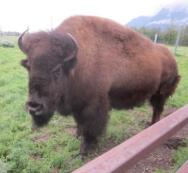
I’ve been doing a fauna count on my Facebook page (1 whale, 5 deer, 8 antelope, etc) but I was stumped today.  We drove from Duluth (where we spent a lovely evening with friends) to Sault Ste Marie MI, and, although I sewed a lot of hexagons, I didn’t see much in the way of animals or birds.  What will I put on my Facebook page tonight for the fauna count?  (I don’t think Da Yoopers count, somehow…)
Then we went out for dinner.  The motel suggested a wonderful restaurant – Antlers – that started its life as a speakeasy during the Prohibition, and now serves really good food with a unique ambience.  Voila!  Fauna!

Dining at the Antlers Restaurant - you've got to keep alert! (Especially if you're a waitress, it seems!)

It is within a month of Hallowe’en now, and tonight we also saw our first full-blown display.  Americans are now decorating their houses with the same enthusiasm as they do at Christmas – they clearly have more a) time, b) enthusiasm, and c) storage space in the garage than we do.

Did I mention enthusiasm?

Tomorrow we cross back over to Canada (just missing a chance for Thanksgiving turkey – but maybe we’ll snag some leftovers…..) and continue our way via another ferry to my brother’s house near Meaford.  There, there will be a presentation involving a quilt.  More later.


The World Wars, the Tapestry and the Garden

October 1, 2011

Before we left France, we spent a couple of days as tourists.  There is much to see, and we focussed our time on the northwest part of the country.  We started with Ypres, a Belgian town an hour away from Gent. During WWI the Germans never occupied the city; instead, they demolished it.  We saw pictures at our B&B of what was left of it.  A small piece of the Cloth Hall, a single archway – the rest was rubble.  The people of Ypres rebuilt the entire town as it was before the war. Now, the Cloth Hall is the Museum (with shrapnel pockmarks in the original masonry still visible).

Cloth Hall in Ypres

When we were there, a huge number of people were in the square to watch a ”tatoo” of three marching bands which included a visit from the Scots Guards.   Every evening since 1928, a Last Post Ceremony is held at Menin Gate, on the east end of the centre of town. The Menin Gate was built to commemorate the Commonwealth soldiers who were missing in action. There are almost 55,000 names inscribed on its walls.

Menin Gate

The Last Post ceremony is hugely moving, and when we were there, the Scots  joined the regular pipe band in the memorial. Perhaps it was because of them that so many people attended.  We arrived an hour before and got a front row spot.  There are tunes played by the pipe band, the Last Post is played by the buglers, 2 minutes of silence, and then family members and military representatives place wreaths (that’s the part that got me – the grandchildren walking slowly towards the memorial, holding a wreath).  Then the Reveille is played and the band(s) march away, playing.

Wreaths of poppies

The Last Post ceremony

While we were in Ypres, we visited the site where Dr. John McRae wrote “In Flanders Fields”. By far the most famous of all the war poetry, it was taught to every Canadian elementary school student when I was growing up.

Essex Farm Cemetery, just outside of Ypres (or Ieper, in Flemish)

World War I saw the front lines in Europe stretch from the North Sea to Switzerland, hundreds of kilometers long.  The line didn’t move very much for four years - it was a stalemate – but they killed and killed and killed.  It was filthy, wet, cold. There were rats and lice and constant danger for the young men. The fortifications were trenches open to the elements and the first year was the worst weather they had had in years. Trenches were laid out in layers as you approached the front line.  Closest to No Man’s Land was the observation trench, followed by two or three more.  They were dug in wavy lines so as not to afford an enemy a direct line of sight for shooting or bombing.  There were elaborate underground structures behind and underneath, sometimes dug by professional miners, with communications and supply centres; they were also a way for soldiers to approach the front lines without being seen.  All of the sites we visited were similar – fenced off areas with huge dimples, pock-marks, holes where bombs had gone off.  Sometimes they would dig underground and set off blasts there, leaving a large hole with a lip, which would offer them some protection from sight.  These areas are extremely dangerous – there are still unexploded shells everywhere.  At Vimy Ridge and Beaumont-Hamel, they could only keep the grass cut with sheep.

Sheep at Beaumont-Hamel stepping lightly

The Vimy Ridge memorial to Canadian soldiers was extremely moving.  This is sacred ground, for Canadians, where they showed their mettle and added a new technique to the making of war. In the taking of the ridge, the soldiers were given thorough instructions about where they had to be when, and why.  Before that, soldiers were just told to do something, but had no idea of the bigger picture.  Turns out that the more information they were given about the battle, the better they did their jobs!

Vimy Ridge Canadian memorial

We took a tour above ground to the trenches, as well as into the subterranian world of the soldiers, tunnels and rooms built by professional miners.

At some points the front lines were only 50 metres away from each other.

The tunnels 30 metres below.

We finished our World War visits at Juno Beach.  World War II was very different from the “War to End All Wars” (WWI).  Hitler had occupied the entire country of France, and instead of the meandering horrible stagnant line of mud and trenches that was WWI,  his fortifications were all on the coast.  On D-Day, the Allied forces were each given a different beach to take as part of the larger effort.  For Canadians, it was Juno Beach in Normandy.  I wrote a song called “Boots and Bayonets” about the Burlington Teen Tour Maching band playing for the 60th anniversary of D-Day there, and it meant a lot for me to go there.

Like Vimy Ridge, Juno Beach is almost Canadian sovereign territory.  There is a dedicated area with a museum featuring a very complete description of Canada’s contribution to WWII.  They had a 9-km stretch to win from the Germans, and that’s a lot of coastline.  The taking of the beach was only the beginning, though – it took another 30 days to cross and win 30 miles to the next town.  We toured one of the German observation posts, still extant, with 3 metres of concrete protection, then headed to the beach to learn about what happened on the day, June 6, 1944.

Looking toward the beach from the Canadian museum at Juno Beach

It was enough.  Two days of immersion into the World Wars, and we had only one day left in our quick visit to France.  We spent the night in Bayeux, where John made his acquaintance with the local security guy, who always seemed to be vigilant in the hallway of our hotel.

The next morning we visited the 1000 year old Bayeux Tapestry, commemorating the Norman Conquest of 1066 – a very different war than the more recent ones, but nonetheless very bloody.  The Tapestry is embroidered wool on linen, and, for something so “long-in-the-tooth”, is in REMARKABLE shape!  It stretches for almost 70 metres (230 feet) and is now kept under glass and muted lighting – although it once was taken out for display every year and hung around the periphery of the Bayeux Cathedral.  There is much to tell you about this, but you can find out for yourself by clicking here.  Of course, no photographs were allowed.  My thought on seeing the tapestry was this: maybe I should start working in linen and wool embroidery – otherwise, I doubt if any of MY work will last 1000 years!

We finished up back at John’s cousin’s home.  Near where she lives is Giverny, and Faith highly recommended a visit there.  Of course, this is where Monet’s garden is.  At this time of year, the garden is stunning – it’s huge, and the flowers were tall and profuse.  The sunflowers towered over us, and there were dahlias and daisies and even an iris (at this time of year?).  His house overlooks the garden. This is the view from his bedroom window.

Monet's Garden

The house inside was painted with vibrant colours, like you would expect in an artist’s house – the dining room was bright yellow, and the kitchen was all blue and white tiles.  His studio room had, perhaps, 60 reproductions of his work – amazing to see them all together.

The place was overrun with tourists and locals alike – it was a hot summery day and walking through the garden seemed to be the perfect thing to do.  Very popular was the water garden, where we were all snapping away on digital to catch the reflections and peaceful vistas. Trying to see like Monet did…..

Monet's Waterlilies

What a perfect way to end our French adventures!  It has been only 2-1/2 weeks since we left home, and we’ve packed a lot into that time.  There is still so much to see in France, and I hope it won’t be too long before we can return.  In the meantime, I must continue to improve my French, or at least not lose what I’ve gained.  I look forward to returning to the baguettes, the cheese and the wine. À la prochaine!!

Dutch Glass and Deltaworks

September 28, 2011

We had a very important trip to do after we left Belgium.  We were so close to where John’s father was born, we had to drive up and see it.  John’s grandfather was commissioned to engineer the upgrade to the Leerdam Glassworks, and lived there between the years of 1911-1918. The glassworks are still there, keeping the village alive.  There is a glassworks museum too, that is in two houses: the house that John’s grandfather had built, and another built by his employer at the same time.  That they didn’t get along very well was very well known back then, but today the two houses are joined in harmony by the museum.

The house on the right was built by John's grandfather.

We spent some time watching glass blowers working in a studio built for tourists in the village.  It’s always amazing to see what they do, and how long it takes to form a single piece.  It was a hot day, and we didn’t envy them their hot work.

It was great to get back to Holland.  We immediately noticed more bicycle paths, very well used by the natives and tourists.  It’s a flat country, and last time we were there (in Amsterdam) we found it impossible to take a picture without a bicycle (or 10!) in the picture.

We did a big loop in our drive that day, and drove along some of the dykes and dams they have constructed to keep the sea out of this low land.  It seems the country would be half its size without these dykes.  Kinderdijk is a real tourist trap, and we stopped only to snap a few pictures.  It was overrun with tourists from the river/canal cruise ship parked nearby.  These windmills are used to keep the water flowing out and the dykes have been built to do the same thing.  We were driving below the dyke at one point, metres below the river level.

Windmills at Kinderdijk

Vincent van Gogh was born in  Zundert, Holland, and they have a statue of him and his brother on the main street.

On our way back to Belgium, we drove along the outer perimeter where technology meets the sea.  The Dutch embrace all kinds of natural power (as well as the normal kinds).  We saw modern windmills everywhere – they have a long history with harnessing the wind – and also drove over the dams that keep the salt water away from their land.  This is part of what’s known as the Deltaworks, an absolutely huge endeavour which was only just completed in 2010. The sluices open during low tide, so the water can drain out, and close during high tides, so no saltwater can enter.  It is a very effective (and costly) way to keep their land intact.

Windmills and one of the dams of the Deltaworks

The weather is wonderful, warm and sunny.  It could have so easily been rainy and cold, so we’re thoroughly enjoying it.  The next part of our journey is to World War sites in France.  We plan to do to the Canadian monuments of WWI and WWII to learn more about our country’s contribution.


Follow

Get every new post delivered to your Inbox.

Join 79 other followers